To be honest, I ignored the invite to enter the APLD competition the first time I heard about it. It had been a long year, and I felt I was no longer a student and had left those college projects behind me. However, Sally Court, our vice principal sent round a follow-up, and when it comes to Sally, I like to oblige......
So, come January, I found myself looking back at all those old files, and wondering if I really had time to take it on. I did some research, and found that an Oxford College of Garden Design student, Tracy Rich, had been runner-up the year before, so, rather cheekily, I emailed her and asked for any feedback she may have. She said to make sure it was all clear and particularly well labelled, to make it as easy for the judges as possible. Well, I do love a good competition, and I now had the bit between my teeth, so was up and running......
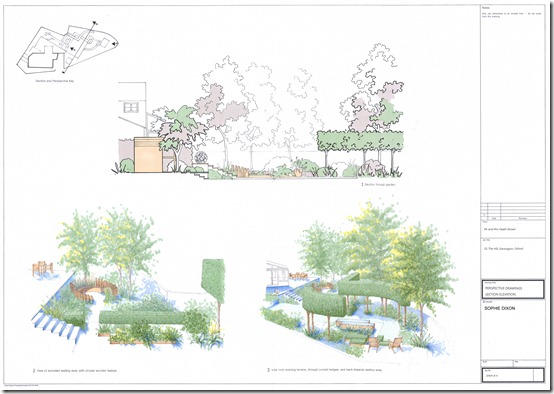
The first decision was which project to enter. Project three was obviously the big one, my final piece of college work. This should have been my best, and was certainly my most comprehensive in terms of quantity. However, there was no way you could submit the lot.... there were about 70 pages of technical sheets for a start! And I wondered if its large scale actually counted against it. However the most important factor was that the same project had been used the year before by Tracy, so the judges had already seen that site. Project two by comparison was felt (by Duncan and Sally) to be very well suited to the US market in terms of scale, and I was very happy with it. Decision made.
It was actually more work than I had anticipated, as some of my sketches needed re-doing because they had never been scanned, and were looking a bit world-weary after being through several exhibitions. They also requested a written description of up to 1,000 words, which was something we hadn’t had to include as part of the coursework for college. This description could include things such as; design intent and project program, relationship of design to site conditions and limitations, relationship of plants to other elements, outline of scope of project and designer’s specific mandate and availability of on-going maintenance. I decided it was worth spending some time on this, as it is the best way of giving the judges real understanding of the project, the difficulties of the site and the design decisions I had made. It had been a very tough brief, and I wanted them to realise it!
I left much of it to the last minute as always..... and was sending the work sheets through electronically in the early hours of the morning. They had set up a new system of uploading, and the whole thing was a bit untried and tested. There were the usual technical issues, and I certainly would advise trying to give yourself a bit more wriggle-room than I did! I think my final sheet uploaded about an hour before the deadline, which was a massive relief.

It was all a bit of an anti-climax after that, with delay after delay from the APLD. Then suddenly Sally Skyped to congratulate me. I hadn’t heard anything, so it was a bit of a bolt from the blue. The email saying I had won had never turned up........
Anyway, the important thing was that they liked it. Here is some of the positive feedback I received;
“The designer of this project has a wonderful grasp of form generation and rhythm, and did an exceptional job of relating the landscape to both the architecture and the existing landscape...... The details are very thorough....... The planting compositions are excellent, well integrated, and balanced....... All in all, this project was well conceived and presented.”
“Very good site analysis and concept plan.....Well detailed planting plans with rich diversity and mixed grouping patterns...... All drawings are very professional.”
“A very well executed plan. Design Brief is clear, well written and presents the challenges and solutions in an excellent manner. The Site Analysis with photographs really helped me to understand the project and your design solutions much better. Line weight well presented. Very nice rendering. Congratulations.”
I was invited to the awards ceremony in the San Francisco Bay Area, California, but sadly couldn’t make it. The conference sounded like it would be a valuable experience though; I will definitely try and attend another year.
I would recommend entering competitions as a student, it’s a really good way to start making a name for yourself. I am the only person to ever win both the APLD and SGD student competition, and those sort of accolades help when you are just starting out. I now have a design practice based in North Devon and Bristol, and take on commercial and private projects throughout the South West, UK and abroad. And, yes, I may enter the odd competition now and then....
You can contact Sophie at www.sophiedixon.com