Showing posts with label Construction. Show all posts

Tuesday

APN12 Avoid Damage to Trees by Paving and Excavation

APN 12_Page_1

This blog describes the techniques for the construction of access drives, which may avoid or lessen the damage caused to trees. Compaction of the soil, pollution, changes in soil levels in the root zone and cutting roots can all kill existing trees.

Most tree roots are contained within the top 900mm/3ft of soil. and many of the trees feed roots within the top 100mm/4”.   It may not be wise to make even shallow excavations within the root zone of existing mature trees which are to be retained. Where Planning Permission is needed Local Authorities may make special construction techniques mandatory for any paving and drainage, etc. in what are known as Tree Protection Zones (TPZs).

The objective is to avoid damaging roots, preventing compaction of the soil and to allow water and oxygen to permeate through any construction. Details are shown in the current edition of BS 5837 or APN12 e.g. using a geogrid fabric, Type 1 sub-base and a porous block pavers or a no-fines gravel topping. The area affected should be restricted to >20% of the root zone.

APN12 is a very useful document for all landscape designers and architects and I would recommend all design practices own a copy of APN12 in the design library. APN12 embraces the principles first published as 'Driveways Close to Trees' (APN1) and reviews where the principles may be applied in practice.

Thursday

Does Garden Design Have a Future in these Times of Austerity

Housing Development Bay Area Remains Unfinished

Yesterday the UK officially entered a double dip recession. The first in nearly 50 years. Led by the building industry, it’s predicted that this sector will remain in negative grown for at least the rest of this year.

With house building at an all time low, and Europe and America in the worst recession since the 1930’s, what will happen to the middle classes, that up till now have been the life blood or our industry?

Irish Houseing Estate Abandoned

Garden design as an industry, has had 20 years of unparalleled growth. Prices in the housing market have risen across Europe (and more recently America) at a staggering and in hind-sight, unsustainable rate.

It goes without saying that the housing market and the landscape industry go hand in hand. There have been housing market slumps before and the garden design industry has always recovered.  But this time it could be different. 

Countries like Spain and Ireland have huge housing estates abandoned like ghost towns, and parts of the US have deserted subdivisions, reminiscent of 1930’s dust bowl America, where thousands of acres of farmland where abandoned.

With house price crashes in some countries in excess of 50%, it’s going to take more than a generation to put right these wrongs and as a result, the middle classes are going to be squeezed very hard, for a very long time.

So what effect for the garden design industry?  I believe it’s inevitable that the industry will contract.  More people will be fighting for the smaller bread and butter jobs while the upper end will remain strong. 

Those designers who are properly qualified, stand the best change of making a living.  Charging professional frees and offering a professional service. 

Fewer people will enter the professions; and those that do, will need to do their homework very carefully.  Too many courses cater for the “ladies who lunch brigade”. They focus on the froth, rather than teaching their students the professional practice side of the industry. 

The Oxford College of Garden Design took the decision last year to only offer our on-line course for the foreseeable future. Thus allowing our students to continue to work and earn a living, while they study.

“What most course don’t tell you is that it will take another 2-3 years after you graduate, before you will earn a living”

By pre-recording all our lectures and offering them as downloadable video tutorials student can continue to train while still bringing in a salary.

Too may student graduate, only to then drop out after 12 –18 months because they can’t afford to live.

If you want to thrive in the 21st century you need to think smart, plan ahead and have the best training you can afford.

Tuesday

How to Avoid Your Contractor Going Bankrupt!

iStock_000012894951XSmall

Whether a designer or client, in these hard economic times, you can’t have failed to notice more and more small businesses going to the wall. 

Whether they are nurseries, landscaping or building firms, it’s hard to make a living right now, jobs are scarce and margins tight.

A worst case scenario, is for the contractor to go under, halfway through a job, potentially costing the client $1000’s as well as designer a monumental headache, trying to find another firm to finish the work.

A designer may even be held partly liable, swept up in any legal action. So you need to be doubly careful when selecting contractors to tender and don’t skimp on the due diligence.

Taking a contractor’s word, that they are financially solvent is no longer adequate. Before signing the contract, bank references should be taken up and the client should be advised in writing to to do a credit check with a firm such as Dun & Bradstreet.

However even this may not be enough.  On larger jobs, lasting several months, the contractor could still run into difficulties. Either through poor management, or if one of  their suppliers goes bankrupt and takes them down in the process.

There is little you can do about the latter, but the designer can help manage the contract and at the same time protect the client from paying too much up front before work is completed and materials are on site.

The first and most important document you should insist on, before work starts on site is a daily work schedule. This is a day by day breakdown of what work will be carried out, to include in what order the jobs are to be completed and the number of man days involved.
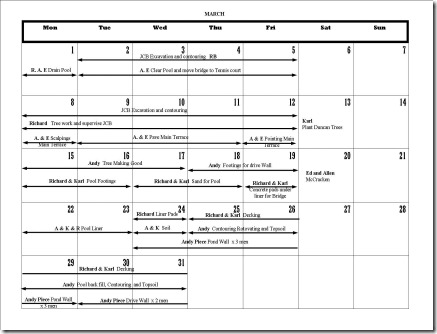
Man Days

Small contractors are sometimes reluctant to provide these, as they involve hours of preparation, but I make this a contractual requirement and won’t let a project start before the client and I have both received a copy.

This document allows all parties to monitor the progress of the job.  The designer and client can see at a glance, that the work is on schedule and the contractor can also plan when materials and plant should be ordered, so the work is not delayed due to material hold ups.

In fact, once the contactors see the benefits of this document they will continue to prepare one for each and every job they do.  Not only will this help protect your clients by keeping the job on schedule it will also likely improve the contractors profitability.

Secondly the designer can protect the client by ‘Project Administering’ the contract. Note the word ‘Administer’ NOT ‘Manage’ Most designers are not qualified to ‘Project Manage’ a site, as this implies quality control and would require the designer to be onsite throughout the build.

At the Oxford College of Garden Design  our students are taught to project administrate jobs. ‘Project Administering’ a contract, involves weekly site meetings to assess the works progress.  The designer can remind the contractor to order materials in good time to avoid delays and is also in charge of signing off the weekly/monthly invoicing.

This involves making sure that the contractor only invoices for work completed and for materials on site. An agreed % is then held back (usually 5%) until the penultimate invoice when only 2.5% is withheld until the final certificate of completion is issued (usually after a defects liability period of 6 months)

By going through this process the designer is ensuring that the client never overpays before work is completed onsite.  In the event that the contractor does go bankrupt, then the client should still have enough funds to bring in a second contractor to finish the job.

Some professional bodies guarantee their members, so it would be worth looking carefully at these and maybe choosing contractor.  Organisations like SPATA (Swimming Pool and Allied Trade Association) in the UK guarantee that if one of their members goes under part way through a job another member will finish the work for the outstanding agreed contract cost.

Finally a last piece of advice is to split large contracts down into smaller ones. Consider different contractors for different parts of the job to spread the risk.

Ground workers for excavation, drainage and contouring; Pool contractors for swimming pools; pond and lake specialists for water features; Stone and masonry specialists for hard landscape features such as paving and walls; Turf/Sod contractors for lawns; Irrigation engineers and lighting technicians; and finally soft landscape specialist. 

I have always preferred women contractors to do my planting, as I consider them more conscientious and careful with young plants.

Saturday

Builder or Landscaper! ….But Which is Better?

iStock_000001645477XSmall

I came across a very interesting blog by Garden Design Lisa Cox this week in which she laments the insistence of clients, to use their own builders for the garden, rather than getting a specialist landscape contractor involved.

Lisa believes that “landscaping is a completely different discipline to a house building project.” and to a certain extent this is true, but when it come to the hard landscape construction, I would be just as happy to employ a good builder, as I would a good landscaper.

The construction of walls, paving and steps are the same in both house and garden, decks and pergolas, are comparable to laying floor and roof joist and even pond construction is similar to tanking a basement or cellar.

Lisa is not alone in this view, as many garden designers share this belief, but some of them don’t appreciate that most, if not all the problems they experience using builders, boils down to their inability, or lack of training, to communicate the construction process and detailing sufficiently.

Very few garden design courses cover professional practice in anyway near enough detail so that students can go out and write sufficiently detailed contracts.

At the Oxford College of Garden Design, we were so worried about this, that we ended up writing our own model specification document, which has now been adopted as the industry standard.

We have just donated it to the Society of Garden Designers in the hope that they may finally start taking some responsibility for garden design education and insist that courses teach specification writing properly and to a minimum standard.

As for Lisa; she does produce both construction detail and a specification document as part of her contract documentation.  May be as she says, she has been unlucky with her builders.

One thing I would say is that the landscapers profession does tend to be less chauvinistic and sexists and may be Lisa was unfortunate enough to run into some dinosaurs who believe women should be in the home and not on the building site……….But that’s a discussion for another time!

Do visit Lisa Cox’s website and also subscribe to her excellent blog