Showing posts with label colour. Show all posts

Monday

Colour In The Garden

Does And Don't On Designing with Colour


Drive through any town or suburb and you will see many plantings that apparently aim to include every possible colour imaginable, all crammed together, with no thought at all for harmony,  balance or indeed the colours and forms of the adjacent or surrounding buildings. 

You wouldn't buy a carpet in such a riot of colours, but colour sense often literally flies out of the window when it comes to exterior colour schemes.

As a very general rule, the more bland the architectural backdrop the bolder your colour scheme can be and vice versa. If , for example the building is a shade of grey, bright colours will work in your scheme. 


New red brick is a difficult foil for successful planting because the strong colour of  the brickwork dominates whatever is close to it – and in a small garden that includes everything.  Your course will teach colour theory,  but even without that knowledge  you should be able to recognise that purples and vivid reds simply do not work against brick, even when if it is aged and weathered. 

Softer colours – pale yellows, cream, grey-greens and  light blues look much better. Why? Because they are cooler and complement  the brickwork rather than fighting it. Light peach, pink and apricot also work against red brick, being watered down versions of the brick colour itself. However these colours are more tricky to carry through into a broader planting scheme.

Even small changes of colour in your client's garden can make a positive difference. Paint a plain garden shed , garden office or summer house in an exact match or tone of one of the colours you will be using in your planting plan. 


It will immediately integrate into the overall scheme and look cool and sophisticated. Likewise any timber structures such as fences, timber seats and  arbors will last longer and act as a much more pleasing backdrop to planting if they are painted in soft earthy colours such as a clay grey, slate blue or sage green.   

For ideas try studying Farrow & Ball or Fired Earth colour cards, both of which contain colour ranges that are ideal for use in the soft light of the United Kingdom and other northern countries. The vivid colours that work so well in the bright light of  the Mediterranean or California are less successful further north, with the exception of  some ultra modern inner city gardens.


Colours can be mixed and matched in a variety of finishes such as exterior eggshell. There are several commercial wood stains and paints available but be careful –  unless you are seeking a bold and vibrant effect some are still not subtle enough for use over large areas and may need to be mixed or thinned.  

Avoid gloss paint, it gives too sharp and shiny a finish  - and don't use a spray gun as it may dribble through to the neighbouring side of the fence and cause a dispute for which you don't want to be blamed!


More thoughts on colour in the garden will follow in future blogs. In the mean time tell us what colours you like and dislike in the garden.


Article by Sue Hook

Wednesday

10 Swimming Pool Design Tips

What To Consider When Planning A Swimming Pool

So assuming you have the resources and the space what should you consider before installing a swimming pool?

1. Firstly, will you use it?

Or at least use it enough to justify its existence. If your weather isn’t consistently warm and sunny are you hardy enough? Can you be bothered to drag a cover off the pool every time you want to use it?

2. Have you got the ideal site:


 Open but sheltered. Away from deciduous trees that will shed their leaves. With easy access to changing facilities and close enough to the house for convenience.
You will also need to connect services the site: water and electricity. How easy and costly will that be?

3. What will you use the pool for?


This will influence its shape and size. If it is just for a quick cool-off dip and a focal point to lounge around then a curved or shaped pool is a possibility.
If you want it for serious swimming exercise then it needs to be big enough, deep enough and ideally rectangular. This was a major factor that put me off. A pool less than 15 metres, 50 feet long, is not a good place to swim.

4. Are you prepared for the cost?


Not only of installation but also of on-going maintenance? Is that something you are prepared to do yourself, or will you employ the services of a maintenance company?

5. What will the impact be on the garden?


If visible from the house, will it be dominant and obtrusive?
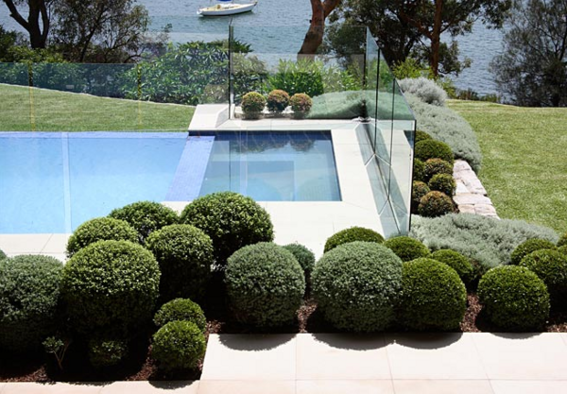
A typical aqua blue swimming pool is pretty startling on a cold, grey day and looks out of place in a traditional country garden. It may be more inkeeping in a contemporary or Mediterranean setting.

6. You could consider a pool of a different colour


It doesn't have to be blue. A natural stone, soft terracotta or clay coloured lining may be far easier to incorporate in your garden design.
Will you use a traditional concrete construction, fibreglass or one of the various vinyl liners available? These are more frequently used today.

7. Natural or Chemical?


Have you considered a natural freshwater swimming pool or swimming pond http://www.naturalpoolsuk.com/ ? These are becoming far more popular.
They definitely sit more comfortably in a naturalistic setting, but this is not the only possibility. Contemporary designs can be stunning.
No chemicals are used because the water filtration is achieved by aquatic plants. Much nicer to swim in; the only disadvantage: cold water!

8.will IT impact on the value of your house?


A swimming pool may or may not add value. It can be a selling point or it can be a disadvantage.
Your swimming pool could put off a buyer that does not want the bother or cost of a swimming pool.

9. What will be the implications if you change your mind?


Removing or filling in a swimming pool can be as difficult and costly as installing it in the first place.
You can’t just fill it in and plant in that location. You will have drainage to consider so the structure of the pool usually needs to be removed and soil, a lot of it, imported to fill the hole.

10. So, if I haven't put you off


Find yourself a good designer and get a specification sheet drawn up by an independent swimming pool engineer to include all the plant machinery and the materials you want to use.
This will mean every contractor will be quoting for exactly the same thing, otherwise it will be impossible to get a like for like quote. 

This one bit of advice alone could save you tens of thousands of dollars alone.

Consider keeping the pool a constant depth. I would recommend  4ft deep (1.2m) This is deep enough to swim in without scraping your knees and will halve the cost of your pool both in construct costs and in heating bills. 

The only disadvantage to this is that you should have a ‘no diving policy’ for the kids, but they will soon get over this.

If you want an electronic pool cover you will need to keep the pool rectangular, but this is also better if you want to use the pool for exercise and games like water volleyball.

Using a darker colour on a rectangular pool can also help disguise its use when situated close to the house.  If planned well, it can be designed to look like a formal pond when not is use.

Avoid ‘Roman Ends’ or  putting the steps in the centre of the pool as this ruins the ability to do lengths when exercising. Instead put them to one side so you can do racing turns without them getting in the way.

Always ask to see examples of contractors previous work in real life situations and try and talk to other pool owners to share their experiences before you take the plunge.

Do the contractors belong to a professional body?  If they do, check to see if they are covered by an indemnity policy just in case they go bankrupt.  Some professional bodies cover the cost of finishing the pool for the original agreed price.

Consider:
USA The Association of Pool & Spa Professionals
USA Florida Swimming Pool Association
UK BSPF | The British Swimming Pool Federation
UK SPATA
AU SPASA | Swimming Pool and Spa Alliance

Finally find an expert you can really rely on to do a good job and deliver a swimming pool that meets or exceeds all your expectations.