Tuesday

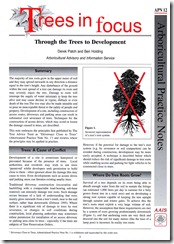
APN12 Avoid Damage to Trees by Paving and Excavation

APN 12_Page_1

This blog describes the techniques for the construction of access drives, which may avoid or lessen the damage caused to trees. Compaction of the soil, pollution, changes in soil levels in the root zone and cutting roots can all kill existing trees.

Most tree roots are contained within the top 900mm/3ft of soil. and many of the trees feed roots within the top 100mm/4”.   It may not be wise to make even shallow excavations within the root zone of existing mature trees which are to be retained. Where Planning Permission is needed Local Authorities may make special construction techniques mandatory for any paving and drainage, etc. in what are known as Tree Protection Zones (TPZs).

The objective is to avoid damaging roots, preventing compaction of the soil and to allow water and oxygen to permeate through any construction. Details are shown in the current edition of BS 5837 or APN12 e.g. using a geogrid fabric, Type 1 sub-base and a porous block pavers or a no-fines gravel topping. The area affected should be restricted to >20% of the root zone.

APN12 is a very useful document for all landscape designers and architects and I would recommend all design practices own a copy of APN12 in the design library. APN12 embraces the principles first published as 'Driveways Close to Trees' (APN1) and reviews where the principles may be applied in practice.

Thursday

Does Garden Design Have a Future in these Times of Austerity

Housing Development Bay Area Remains Unfinished

Yesterday the UK officially entered a double dip recession. The first in nearly 50 years. Led by the building industry, it’s predicted that this sector will remain in negative grown for at least the rest of this year.

With house building at an all time low, and Europe and America in the worst recession since the 1930’s, what will happen to the middle classes, that up till now have been the life blood or our industry?

Irish Houseing Estate Abandoned

Garden design as an industry, has had 20 years of unparalleled growth. Prices in the housing market have risen across Europe (and more recently America) at a staggering and in hind-sight, unsustainable rate.

It goes without saying that the housing market and the landscape industry go hand in hand. There have been housing market slumps before and the garden design industry has always recovered.  But this time it could be different. 

Countries like Spain and Ireland have huge housing estates abandoned like ghost towns, and parts of the US have deserted subdivisions, reminiscent of 1930’s dust bowl America, where thousands of acres of farmland where abandoned.

With house price crashes in some countries in excess of 50%, it’s going to take more than a generation to put right these wrongs and as a result, the middle classes are going to be squeezed very hard, for a very long time.

So what effect for the garden design industry?  I believe it’s inevitable that the industry will contract.  More people will be fighting for the smaller bread and butter jobs while the upper end will remain strong. 

Those designers who are properly qualified, stand the best change of making a living.  Charging professional frees and offering a professional service. 

Fewer people will enter the professions; and those that do, will need to do their homework very carefully.  Too many courses cater for the “ladies who lunch brigade”. They focus on the froth, rather than teaching their students the professional practice side of the industry. 

The Oxford College of Garden Design took the decision last year to only offer our on-line course for the foreseeable future. Thus allowing our students to continue to work and earn a living, while they study.

“What most course don’t tell you is that it will take another 2-3 years after you graduate, before you will earn a living”

By pre-recording all our lectures and offering them as downloadable video tutorials student can continue to train while still bringing in a salary.

Too may student graduate, only to then drop out after 12 –18 months because they can’t afford to live.

If you want to thrive in the 21st century you need to think smart, plan ahead and have the best training you can afford.

Wednesday

Video Tutorial: Understanding Section Elevations


Sections are a vital tool in landscape design.

This video lecture explains what they are, how to use them and also shows examples of plan drawings and elevations, showing how they deliver additional information to the viewer, which is otherwise unavailable in a 2D plan.

Technorati Tags: ,,,,,,,,,

Tuesday

5 Tips for Planning the Perfect Outside Dining Space

Bliss@Kovan-Alfresco-Dining

The dining terrace is without question the most important part of any garden.  It is the link between the artificial environment of the house and the biological environment of the garden. You start and finish your journey round the garden and its the area on which most outside activity takes place.

If the terrace doesn’t work the rest of the garden won’t either!

1) Position

Keep the dining area close to where the food is prepared. You don’t want to have to walk miles with plates and cutlery let alone freshly prepared food.  So for this reason, it is most likely going to be next to the house.  However in is some warmer climates I have built “summer kitchens” which are away from the main home, usually next to the swimming pool or tennis court.  These are fully fitted outside kitchens complete with fridge stove and can be undercover with an adjoining dining area.
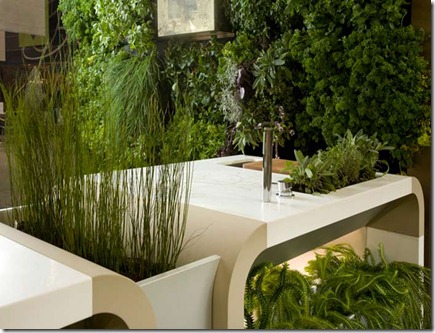
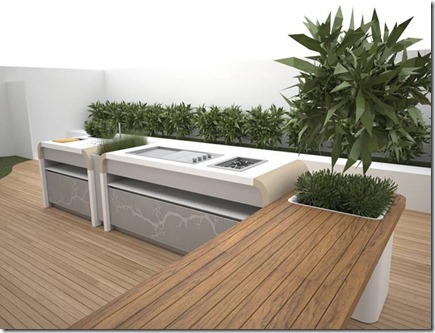
Electrolux-outdoor-kitchen2  Electrolux-outdoor-kitchen3

2) Scale

Scale is vital in all design but even more so when it come to the dinning area.  the first thing you have to remember is that outside furniture is usually significantly larger, therefore you will need a much larger outdoor space than you would if you were planning the same space indoors.   The other major area of importance is circulation space.  i.e. the area around the perimeter of the table for people to move, serve food or pull their chairs out when leaving the table. Unlike interior spaces where people are prepared to squeeze behind chairs to enter or exit, outside you need at least 1m (3ft) behind the chairs to comfortable accommodate pedestrian flow.

OutsideDiningArea

3) Material & Detail

For obvious reasons any surfacing material needs to be hard wearing if the  dining space is to be a permanent fixture. Stone, and concrete, make perfect paving materials while decking works well provided it is sufficiently supported by large enough joints to avoid any bounce.  Because you and your guests will spend so much time in this one position, if budgets and site permit, you can also spend more time and money here on paving detailing,  as it will be more likely to be appreciated.

The exception to the rule is the temporary dining area, which may only be used once then moved.  These are placed on lawns or under trees for their view or their romantic atmosphere

Sabora_OutsideDining

4) Aspect

There is something quite special about eating next to water, be it a swimming pool, pond or even the Ocean, water adds a magical quality to the dining space.  The only proviso would be to double the circulation space to 2m (6ft) as sitting to close to water can give guests an uncomfortable feel.

If you can’t provide water then planting is the next best thing.  Surround the dining area with soft planting that provides a cocooning feel without blocking the views.  Grasses and translucent perennial planting is perfect for this as it created just enough screening without feeling claustrophobic.

Royal-Island-Resort-Spa-Dining-by-the-sea

5) Privacy & Screening

In urban areas, privacy when eating can be difficult to achieve.  In these circumstances an overhead arbour or pergola comes into its own.  Not only do they provide screening, but also create a human scale to the outside space, so important in making people feel comfortable. 

The Arbour doesn’t have to be very heavy to give the subliminal feeling of a roof, but at the same time can control light quality (depending on the choice of climber) and provide shade, as fewer of us now enjoy eating, unprotected from the damaging effects of the sun.

Villa_Prikonas_dine_al_fresco

Duncan Heather is Director and principal of the Oxford college of Garden Design which runs an Online diploma course and 4 week online short courses in all aspects of gardening